



In The Zone
Home
Executive Coaching
Sports Coaching
Teams
Coaching
Articles
About us
Contact Us
Contact Us

Dynamic tension for high performance   -  Tim Goodenough
6 April 2009

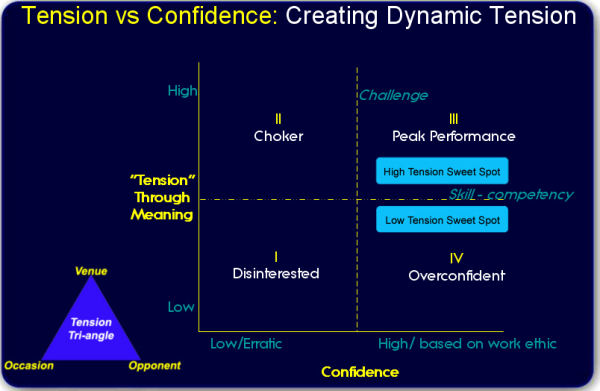
In our work Mike Cooper and I discovered that elite athletes require a unique mix of confidence and tension (sometimes called anxiety) to be at their best on match day.  Some athletes are at their best when they have (relatively) high tension – for example they need to feel the butterflies in their stomach, and others are best at a lower tension, they want to feel a sense of heightened awareness, but nothing more.  When we ask those athletes to give a rating for their ideal tension, it normally is around 6 out of 10 and 3 out of 10 respectively.

When athletes have too much tension, they are often referred to as chokers, and when they have too little tension, they are sometimes called “Slapgat” a South African expression for lazy and disinterested.

Dynamic Tension

In team sports the coach has a massive influence on how tense the team is feeling. In general a coach needs to know who are his high or low tension players, and know the general feeling of the team for match day.  If the team is too tense, he needs to lower the tension for the group (and still speak individually to the high tension players) and if the team is too relaxed, he needs to up the ante – and raise the intensity.  Teams that arrive disinterred for ‘smaller’ games often do so because the coach hasn’t been able to up the tension for the group.  To do this he may say something like, “This game is going to be my trial run for the knockout stages of the competition, if you can perform here where there is no-one cheering your name, you can do it when there are 50 000 people in our stadium. Make this one count!”

All the athletes we have worked with say they want their confidence to be at a high level to perform at their best, typically 8 or more out of 10.  The challenge with this is that many of these athletes have complicated rules on “How to feel confident”; some of those rules are based on superstition and many rules are based on things that have their own unique variability.  Many rugby players I speak to say they base their confidence on how they are feeling in training, and what the coach is saying to them.  This means that if they have an ‘off’ training day, which happens, or the coach forgets to say the correct thing to them, or doesn’t have time to, or worse still doesn’t know what the correct thing to say is – their confidence starts to see-saw.  This is before we add in some of the superstitions, lucky socks, lucky jocks, what the press are saying, what their team-mates are saying, what other members of the management are saying, what their family, friends and wives/girlfriends are saying ... etc etc.

Once athletes understand that they will have ‘off’ training days, where they are not at their very best, and that if they are going to outsource their confidence to something out of their control, they are leaving their form to be influence by chance, they ask the question – what then should I base my confidence on?  For many the answer is simple: base your confidence on your work ethic.  If you know that, come game day, that you couldn’t be more prepared, couldn’t have worked harder, and couldn’t be fitter or stronger – no stone was left unturned – it takes a lot of pressure off you, because now all you can be is your current best.  This still leaves space for the ‘future best’ to be better, an important distinction.

So ideally a top rugby player knows what kind of tension he needs to perform his best on match day, and he knows that his confidence will be high and not based on circumstance, because he is confident because of how hard he worked.  The next step is to check his current level of tension pre-match day, and learn to lower or raise his tension to whatever is required.  Typically there are three major factors affecting tension; the occasion, the opposition and the venue.  The key to each is to ask the player, “What meaning do I give this?”  “Does this meaning give me the correct level of tension for the game?” If not, what meaning can I give this that will?

Here coaches can often struggle with their team, as for big occasions, they will ‘frame’ or label the game in a certain way, and that will work for some of the players, but most of the time not all of them.  The coach saying things like,”This is it boys, this is what our whole season is about.” To players they are already too tense doesn’t help.  For me this is a major reason why most finals are of a poor relative quality, tense players have their tension heightened by the coach, and play at a lower level than their best.

 If a coach wanted to lower the tension for the team for an important game he might say something like, “I know we have spoken about this game for some time, and many of you have dreamt about it. I know how incredibly hard we have worked, and with that being said, the game is still played between the same lines, on a grassy field, 22 against 22. Rugby is the same game it was all season long. Let’s do what we have done all season long – again. In my mind our performances this year have already won us this trophy, our job on Saturday is to let the others know.”  This would validate the feelings amongst the team, as well as re-position the game as being important, but not the MOST important thing.  Successful coaches have the knack of validating the feelings of the team, as well as re-positioning any important event to become something that works for the majority of the team.


The latest distinction in tension that Mike has come up with is this; Is my tension a Pull tension (such as wanted to play the best team in the world, express my talents, put it all on the line) or a Push tension? (I can’t stuff this up, I can’t get this wrong, this is my one chance if I don’t take it I am finished,  if I don’t play well I will lose my place in the side, I will let my country down if we don’t win the World Cup)  Again the meaning a player gives to his tension is key, the important aspect is, what works for you; high or low tension, push or pull tension or a combination – and are you replicating your successful tension and confidence formula as often as possible?

Well – are you?

    © Coaching Unity 2014 - All Rights Reserved